Can you drive a golf cart on the road? Where, when and with what
A golf cart is legal on a public road only where a town has said so, and the town will also have said which roads, what hours and what the cart has to carry. Here is the pattern those ordinances follow and the equipment that satisfies nearly all of them.
We pick from published specs, maker instructions and what owners report. We may earn a commission from links on this page; it never changes what we recommend. How we choose
The short answer
Only where a city, county or community ordinance allows it. Most golf cart ordinances limit carts to streets posted at 25 mph or less (some go to 30 or 35), to daylight unless the cart has headlights, taillights and turn signals, and to marked crossings of bigger roads. A cart built and registered as an LSV can generally use any road posted 35 mph or less. No ordinance puts a golf cart on a highway.
- A golf cart can use a public road only where a city, county or community ordinance allows it.
- Most ordinances limit carts to streets posted 25 mph or less and allow crossings only where named.
- Expect about $250 to $700 in lights, mirrors, horn and belts, plus a permit sticker in many towns.
- A registered LSV can generally use roads posted 35 mph or less, and no ordinance puts a cart on a highway.
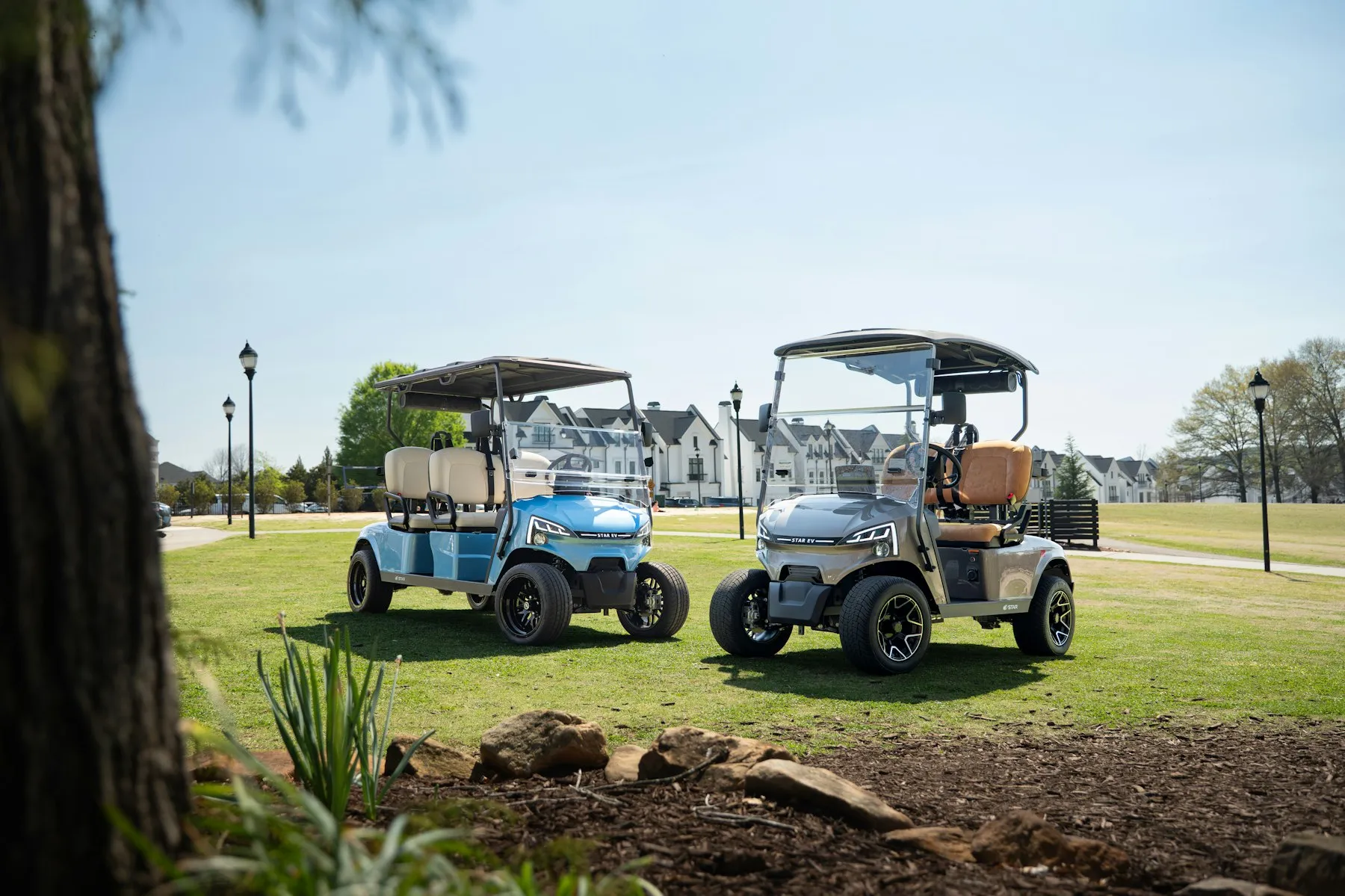
Our picks at a glance
Prices are estimates as of Oct 17, 2026
The picks in detail
1.Golf cart street legal light kit with turn signals, horn and brake lights
Fits: Model-specific kits for Club Car DS and Precedent, EZGO TXT and RXV, Yamaha G-series and Drive; check voltage and year
At Amazon. We may earn a commission.
Pros
- Covers the lighting and horn most ordinances list
- Fits the factory cutouts with a harness
- About an afternoon to install, owners report
Cons
- 48V carts may need a separate reducer
- Lithium carts need a higher-rated reducer
Why we picked it
Headlights, taillights, brake lights, turn signals with a column switch and a horn are the equipment list in most ordinances, and a model-specific kit puts them in the factory cutouts with a harness that reaches. Add mirrors and belts and you have what the permit inspection wants. Most owners report an afternoon for the install, longer if the kit needs a voltage reducer.
Before you buy: 48V carts need a 48V-to-12V reducer if the kit does not include one, and some kits for lithium carts need a reducer rated for the pack's higher resting voltage.
You can drive a golf cart on the road where a local ordinance has opened the road to carts, and nowhere else. A golf cart is not built to federal motor vehicle standards, so a state cannot register it as a car, and the default rule on every public road in the country is that it does not belong there. Cities and counties, often under a state law that permits them to, pass ordinances that make exceptions for specific streets under specific conditions. In a cart town, those conditions are what “legal” means.
This is one of the owner guides; if you have not already, read do you need a license alongside it, and if children will drive, how old you have to be. All three come down to the same ordinance.
Which roads: the speed limit rule
Nearly every golf cart ordinance is written around posted speed limits, because a stock cart does 12 to 15 mph and a modified one 19 or so, and a 15 mph vehicle on a 45 mph road is the thing the ordinance exists to prevent.
The common pattern is streets posted at 25 mph or less. Some towns go to 30 or 35 mph, usually with extra equipment required, and a few limit carts to a map of named streets rather than a speed threshold. Roads above the threshold are off limits for travel, with crossings handled separately.
Registered LSVs sit one tier up. The federal rule defines an LSV as a four-wheeled vehicle with a top speed over 20 mph and no more than 25 mph, and most states let LSVs travel on roads posted at 35 mph or less. That is the difference between a lifted cart with lights and a titled LSV: ten more miles an hour of posted limit. What an LSV is explains why one is a car to the state and the other is not.
Crossings
A cart town has roads carts can use on both sides of a road carts cannot, and the ordinance deals with that by naming crossings: at a signalized intersection, at a stop sign, at a marked cart crossing with signs, usually perpendicular and straight across. Driving along the bigger road for a block to reach the next street is the most common ticket in cart communities.
Some ordinances add that crossings are only allowed where the bigger road is posted at a certain limit, and some require the cart to yield to everything. If your route includes a crossing, read that paragraph of the ordinance twice.
Hours
Carts with no lights are usually limited to daylight: sunrise to sunset, or half an hour either side. Carts with headlights, taillights, brake lights and turn signals are usually allowed at night where the ordinance allows carts at all. Some towns require reflectors or a slow-moving-vehicle triangle for night use regardless of lights.
Equipment: what the ordinance will ask for
The lists vary, but the overlap is large. Most ordinances ask for some or all of:
- Headlights and taillights, with brake lights.
- Turn signals, front and rear.
- Mirrors: a rearview and at least one side mirror; some want both sides.
- A horn.
- Seat belts for every seat, often specifically for children.
- Reflectors or reflective tape, sometimes a slow-moving-vehicle emblem.
- A windshield, in a minority of towns.
- A permit sticker issued after an inspection, often about $25 to $100 a year, sometimes with proof of liability insurance.
That list is about $250 to $700 in parts for a typical cart. How to make a golf cart street legal walks the install; the light kit guide and the turn signal kit page cover the lighting, mirrors and seat belts the rest. The pick above bundles the lighting and horn.
Two technical notes. A 36V or 48V cart needs a voltage reducer to run 12V lights unless the kit includes one, and a lithium cart needs a reducer rated for the pack’s higher resting voltage (a 48V lithium pack sits near 53 volts). And a light kit does not change the cart’s legal class; it satisfies a golf cart ordinance, it does not make an LSV.
Rules of the road once you are on it
Ordinances usually say the cart follows all traffic laws that apply to a motor vehicle, which means stop signs, signals, lane position and right of way, plus a few cart-specific lines: no more riders than seats, nobody standing or on the rear deck, keep right and let traffic pass, and no towing people on anything. Impaired driving laws apply the same as in a car; owners have lost their driver’s licenses over a cart ride home from the clubhouse.
Towns also tend to ban carts from sidewalks, bike lanes and multi-use paths unless a path is built and signed as a cart path. Golf communities with their own path network usually publish a map.
Private roads and HOAs
Streets inside a gated community that the HOA owns are private, and the HOA sets the rules. Many HOAs publish a cart policy with its own age minimum, sticker, speed cap and equipment list, and it can be stricter than the town’s. If the community’s streets have been deeded to the town, they are public, the town ordinance governs, and the HOA policy is layered on top. Ask the office which kind you have.
How to find your rule
Search your city’s and your county’s websites for “golf cart ordinance” and read the whole thing; they are short. If nothing turns up, call the clerk or the police non-emergency line and ask whether carts are allowed on streets at all. If the answer is no, the only legal way onto the road is a factory LSV or a cart converted and titled as one, which the street-legal guide covers. If the answer is yes, buy the equipment the ordinance lists, get the sticker, and drive like a pickup is coming around the corner, because one is.
Questions owners ask
Is it legal to drive a golf cart on the road?
Only where a local ordinance says so. Golf carts do not meet federal motor vehicle standards, so they are not allowed on public roads by default; a city or county has to open specific roads to them, and most that do limit carts to streets posted at 25 or 30 mph or less with lights, mirrors, a horn and belts. No ordinance in writing means no.
Can a golf cart cross a highway?
Usually only at a crossing the ordinance names, at a signal or a stop, and never by driving along the highway. Many cart towns post signs at the approved crossings. A registered LSV may cross roads posted above 35 mph at an intersection but still may not travel on them.
Can you drive a golf cart on the sidewalk or a bike path?
Almost never. Sidewalks are for pedestrians in nearly every ordinance, and multi-use paths generally ban motor vehicles including carts unless the path was built as a cart path. Golf communities that have dedicated cart paths mark them; if it is not marked, assume it is not allowed.
Can I drive a golf cart on the road at night?
Where the ordinance allows carts after dark, it requires working headlights, taillights and usually turn signals and reflectors. Many ordinances limit carts without lights to sunrise to sunset. A light kit is the first thing to buy if you plan to drive home from dinner.
Not sure it fits your cart?
Pick your make, model and year. We'll tell you the voltage and which parts fit.
Keep reading
All owner guides guides
Do you need a license to drive a golf cart?
On private property, no; the owner sets the rules. On public roads, most local ordinances that allow golf carts require a valid driver's license, and a low-speed vehicle (LSV) is titled, registered and insured like a car, so a license is required everywhere. Check your city or county ordinance before the first public street, because a town with no ordinance has not allowed carts at all.
Owner guideUpdated Nov 5, 2026

How old do you have to be to drive a golf cart?
On your own property, any age the owner is comfortable with; no law reaches the back yard. On public roads where carts are allowed, most ordinances require a valid driver's license, which means 16 in most of the country, and a few golf communities set 14 or 15 with a permit or a supervising adult. An LSV is a motor vehicle and always needs a licensed driver.
Owner guideUpdated Nov 5, 2026
How to make a golf cart street legal: the equipment list and costs
In most of the US a golf cart becomes street legal one of two ways: your city or county passes an ordinance allowing carts on certain local roads with a short equipment list (usually lights, mirrors, a horn and reflectors), or the cart is built or converted to the federal low-speed vehicle standard (20 to 25 mph, 17-digit VIN, lights, signals, mirrors, seat belts, windshield, parking brake, reflectors) and titled and registered through the state. Check your local ordinance and state DMV before buying parts, because the list and the process are set there.
GuideUpdated Nov 5, 2026