48 volt golf cart batteries: six 8V, four 12V, eight 6V or lithium
There are four ways to make 48 volts under a golf cart seat, and your tray decides which three you can use. Here is what each layout costs, how far it goes, and the picks for each, including the point where lithium starts winning.
We pick from published specs, maker instructions and what owners report. We may earn a commission from links on this page; it never changes what we recommend. How we choose
Key takeaways
- Buy the layout your tray was built for: six 8V, four 12V or eight 6V all make 48 volts.
- Six Trojan T-875s are the default set for most 48V carts, at about $1,260 to $1,680.
- An East Penn set sold as Interstate, Duracell or Deka costs 20 to 30 percent less and suits light use.
- If the cart runs most days, price a 105Ah lithium pack; it drops about 300 pounds and usually wins by year six.
Our picks at a glance
Prices are estimates as of Oct 17, 2026
- 1Best overall, six 8VTrojan T-875Club Car DS 1995 and later, Precedent from mid-2008, Onward, Tempo; EZGO TXT48 2010 and later; Yamaha G19, G22, 2011 and later Drive, Drive2about$210–$280
- 2Best for four-slot cartsTrojan T-1275EZGO RXV; Club Car Precedent 2004 to mid-2008; 2007 to 2010 Yamaha Drive (G29); any six-slot tray as a budget swapabout$300–$390
- 3Most capacity, eight 6VTrojan T-105Yamaha Drive and Drive2 built with the factory eight-battery option; any cart with eight 6V slotsabout$190–$250
- 4Best value flooded setInterstate or Duracell GC8 and GC2 (East Penn built)Any 48V cart; buy the case size that matches your trayabout$150–$220
- 5Best lithium packEco Battery 48V 105AhAny 48V Club Car, EZGO or Yamaha with the model-specific tray kitabout$1,900–$2,500
- 6Best value lithiumRoyPow 48V 105AhAny 48V cart; universal tray with brackets for Club Car, EZGO and Yamahaabout$1,500–$1,900
The picks in detail
1.Trojan T-875
8V 170Ah at the 20-hour rate, GC8 case, about 63 lb; six make a 48V set
Fits: Club Car DS 1995 and later, Precedent from mid-2008, Onward, Tempo; EZGO TXT48 2010 and later; Yamaha G19, G22, 2011 and later Drive, Drive2
At Amazon. We may earn a commission.
Pros
- About 8.2 kWh for the set
- Owners report five to seven years with monthly watering
- The layout most 48V carts were built around
Cons
- Six batteries to water every month
Why we picked it
Six T-875s is the set most 48V carts were built around and the one most shops reach for. About 8.2 kWh for the set, 380 pounds, and owners who water monthly report five to seven years. It is the sensible middle of the three flooded layouts: more capacity than four 12V, less weight and cost than eight 6V. If you have six slots, start here.
Before you buy: Six batteries means six to water. Budget 15 minutes a month or add a watering kit.
2.Trojan T-1275
12V 150Ah, GC12 case, about 82 lb; four make a 48V set
Fits: EZGO RXV; Club Car Precedent 2004 to mid-2008; 2007 to 2010 Yamaha Drive (G29); any six-slot tray as a budget swap
At Amazon. We may earn a commission.
Pros
- Set weighs 50 pounds less than six 8V
- Fewer cells to water, fewer connections to corrode
Cons
- About 12 percent less capacity than six 8V
- About 82 lb each, the heaviest single battery
Why we picked it
The RXV came with four 12V batteries and the T-1275 is the one to put back. Four of them is about 7.2 kWh, around 12 percent less than six 8V, but the set weighs 50 pounds less and costs a little less too. Fewer batteries also means fewer cells to water and fewer connections to corrode.
Before you buy: Heaviest single battery of the picks here. Lift with a strap, not by the posts.
3.Trojan T-105
6V 225Ah at the 20-hour rate, GC2 case, about 62 lb; eight make a 48V set
Fits: Yamaha Drive and Drive2 built with the factory eight-battery option; any cart with eight 6V slots
At Amazon. We may earn a commission.
Pros
- Most capacity of any layout, about 10.8 kWh
- Every dealer stocks it, cheap for what it is
Cons
- Nearly 500 pounds of lead in the set
- Eight batteries to water
Why we picked it
Eight T-105s is 10.8 kWh, a third more than six 8V, which is why Yamaha offers it as the long-range option on the Drive and Drive2. The T-105 is also the most widely sold deep-cycle battery in the country, so it is cheap for what it is and every dealer has it. The cost is weight, nearly 500 pounds of lead, and eight batteries to water.
Before you buy: Yamaha trays are tight; the taller T-125 and T-145 will not clear the seat on every model year.
4.Interstate or Duracell GC8 and GC2 (East Penn built)
8V about 165Ah or 6V about 215Ah depending on the case
Fits: Any 48V cart; buy the case size that matches your tray
At Buggies Unlimited. We may earn a commission.
Pros
- Set costs 20 to 30 percent less than Trojan
- The East Penn batteries most carts actually run on
Cons
- About a year less life under daily use
- Capacity labels vary from retailer to retailer
Why we picked it
Interstate, Duracell and Deka golf cart batteries come out of East Penn in Pennsylvania and are the batteries most carts actually run on. Capacity sits a few percent under the Trojan equivalent and owners report a year or so less life under daily use. For a cart that does a handful of miles a day, the gap is small and the set costs 20 to 30 percent less.
Before you buy: Capacity ratings vary by retailer label; compare amp-hours at the 20-hour rate, not reserve minutes.
5.Eco Battery 48V 105Ah
48V 105Ah LiFePO4, about 5.4 kWh, app, 8-year warranty
Fits: Any 48V Club Car, EZGO or Yamaha with the model-specific tray kit
At Amazon. We may earn a commission.
Pros
- Takes about 300 pounds out of the cart
- Model-specific tray kits make it a two-hour job
- Eight-year warranty and an app
Cons
- Bare pack needs its own tray and charger
- Two to three times a flooded set up front
Why we picked it
One pack replaces the whole set and drops 300 pounds out of the cart. 105Ah sounds small next to a flooded set, but lithium delivers nearly all of its capacity where flooded delivers about half before you start shortening its life, so real range is similar or better. The tray kits for Precedent, DS, TXT, RXV and Drive are what make it a two-hour job instead of a fabrication project.
Before you buy: Buy the kit for your model. The bare pack needs its own tray, hardware and charger.
6.RoyPow 48V 105Ah
48V 105Ah LiFePO4, 200A BMS, charger included, 5-year warranty
Fits: Any 48V cart; universal tray with brackets for Club Car, EZGO and Yamaha
At Amazon. We may earn a commission.
Pros
- Charger included in the box
- A few hundred less than the Eco pack
Cons
- Five-year warranty, three years shorter than Eco
- Universal tray may need shims
Why we picked it
Same capacity as the Eco pack for a few hundred less and a charger in the box, which brings the all-in price within reach of two flooded sets. The 200A BMS is fine for a stock controller. You give up three years of warranty and the model-specific tray; the universal tray fits but may need shims.
Before you buy: If you have upgraded the controller past 300A, the BMS will trip on hills. Look at the 250A-plus packs instead.
A 48 volt cart runs on six 8V batteries, four 12V batteries, eight 6V batteries or one lithium pack, and the tray under your seat was built for one of the three flooded layouts. Stay with that layout and buy a matched set, Trojan if you drive daily and an East Penn brand (Interstate, Duracell, Deka) if you do not. If the cart works for a living, price a lithium pack before you buy lead.
This is the decision page for 48 volt golf cart batteries in the batteries guide. Once you know your layout, the 8-volt, 12-volt and 6-volt pages go deeper on each, and the battery calculator runs the ten-year cost against lithium for your miles and your prices.
Confirm you have a 48V cart
Lift the seat and count. Six 8V, four 12V or eight 6V is 48 volts. Six 6V is a 36 volt cart and belongs on the 36V lithium page or the 6-volt page, not here.
By model, Club Car DS carts are 48V from 1995 and the Precedent, Onward and Tempo always were. EZGO TXT carts are 36V through 2009 and 48V from 2010 as the TXT48; the RXV is 48V. Yamaha G19, G22, Drive and Drive2 are 48V; G14 and G16 are 36V. The fitment finder sorts it from the serial number if the tray is empty.
The three flooded layouts, side by side
Each layout fills roughly the same tray with a different number of cells, and the number of cells per case decides how much lead each cell gets.
| Layout | Example set | Capacity | Weight | Set price, about | Found in |
|---|---|---|---|---|---|
| Six 8V | Trojan T-875, 170Ah | 8.2 kWh | 380 lb | $1,260 to $1,680 | Club Car DS, Precedent from mid-2008, Onward, Tempo; EZGO TXT48; Yamaha G19, G22, 2011 and later Drive, Drive2 |
| Four 12V | Trojan T-1275, 150Ah | 7.2 kWh | 330 lb | $1,200 to $1,560 | EZGO RXV; Precedent 2004 to mid-2008; 2007 to 2010 Yamaha Drive |
| Eight 6V | Trojan T-105, 225Ah | 10.8 kWh | 500 lb | $1,520 to $2,000 | Yamaha Drive and Drive2 with the factory eight-battery option |
Eight 6V goes farthest and costs the most in money, weight and watering. Four 12V is lightest and cheapest and goes the shortest distance. Six 8V is the compromise most of the industry settled on. None of them is wrong; the one your tray was built for is almost always the one to buy.
Can you switch layouts
Within reason. A six-slot tray will hold four 12V with the hold-downs moved and two slots empty, which saves a couple of hundred dollars and costs about 12 percent of range. Owners do it, it works, and the cables usually need to be longer; the battery cables page has lengths.
Going the other way is harder. You cannot fit eight 6V in a six-slot tray without a new tray, and a four-slot RXV tray does not take six 8V without the six-battery tray EZGO sells for the swap. Taller batteries (T-890, T-125, T-145) add 20 to 30 amp-hours per battery but need to clear the seat frame, which they do on most Club Cars and do not on every EZGO or Yamaha. Measure before you order.
Flooded against lithium at 48V
A 48V 105Ah lithium pack is about 5.4 kWh, which looks like less than any flooded set. The difference is how much you can use. Run a flooded set past half and you shorten its life every time, so a six-8V set realistically offers about 4 kWh a day. Lithium lets you use about 90 percent, so 4.9 kWh, with the pack weighing 80 to 100 pounds instead of 380.
Up front, lithium is two to three times a flooded set. Over ten years the picture flips for a daily cart: a second flooded set at year five or six, a slow loss of range from year two, water, terminal cleaning and the cart’s own weight all count against lead. For a cart used a few times a month it does not flip, and the lithium guide says so plainly. The 48V lithium page compares packs once you have decided.
Trojan or the cheaper brand
Trojan batteries use thicker plates and a denser paste than most, and that shows up as an extra year or two under hard daily cycling. If the cart does 15 miles a day and gets run down to the last bar, Trojan earns its premium. The Trojan page explains the lineup.
If the cart does three miles to the clubhouse and back and goes on the charger every night, an East Penn battery sold as Interstate, Duracell or Deka will serve nearly as long for 20 to 30 percent less. Crown and US Battery are the other US makes worth buying. What matters more than brand is buying a fresh set, watering it, and charging after every use.
Which set for your cart
| Cart | Layout | Flooded pick | Lithium pick |
|---|---|---|---|
| Club Car Precedent mid-2008 and later, Onward, Tempo | Six 8V | Trojan T-875 or Interstate GC8 | Eco Battery kit |
| Club Car Precedent 2004 to mid-2008 | Four 12V | Trojan T-1275 | Eco Battery kit |
| Club Car DS 1995 and later | Six 8V | Trojan T-875 | Eco Battery kit or RoyPow |
| EZGO TXT48 2010 and later | Six 8V | Trojan T-875 | RoyPow or Eco Battery |
| EZGO RXV | Four 12V | Trojan T-1275 or Interstate GC12 | Eco Battery RXV kit; check pack height |
| Yamaha G19, G22, Drive, Drive2 | Six 8V (eight 6V on option carts, four 12V on most 2007 to 2010 Drives) | Trojan T-875, or T-105 for an eight-slot tray | Eco Battery Yamaha kit |
The fitment pages for Club Car, EZGO and Yamaha have the serial plate locations and model year tables.
Install notes
A flooded set is an hour to ninety minutes. Photograph the wiring, set a Club Car or RXV to Tow, pull the main negative first, then the positive, then the jumpers, and lift each battery out with a strap. Clean the tray, set the new batteries in the same orientation, and wire them in series following the 48 volt diagram for your make. Charge to full before the first drive and check the water level after that first charge; new batteries often take a little.
Replace any cable that is green or stiff while the tray is empty. A corroded main cable drops voltage under load and will make a new set feel like an old one.
Questions owners ask
How do I know my cart is 48 volts?
Count the batteries and read the label on one. Six 8V, four 12V or eight 6V is 48 volts. Six 6V is 36 volts. By model, Club Car DS from 1995, Precedent, Onward and Tempo are 48V; EZGO TXT from 2010 (TXT48) and RXV are 48V; Yamaha G19, G22, Drive and Drive2 are 48V. If the batteries are already out, the fitment finder works from make and year.
Can I mix 8V and 12V batteries to make 48 volts?
The math can work, three 8V and two 12V add to 48, but do not do it. Batteries of different voltages have different capacities and charge at different rates, so the smaller ones get overcharged every cycle and the set dies early. One voltage, one brand, one purchase date.
How much does a set of 48 volt golf cart batteries cost?
About $1,000 to $1,700 for a flooded set installed yourself in 2026, depending on brand and layout. Six Trojan T-875s run about $1,260 to $1,680; four T-1275s about $1,200 to $1,560; eight T-105s about $1,520 to $2,000. An East Penn set is 20 to 30 percent less. Lithium is about $1,500 to $2,500 for a 105Ah pack with tray kit and charger.
Is lithium worth it for a 48V cart?
If you drive most days, yes; the calculator usually shows lithium ahead by year six once you count a second flooded set, water and the range you lose as flooded ages. If the cart goes out a few times a month and lives on its charger, a flooded set is cheaper over ten years and the honest answer.
How far does a 48V cart go on a charge?
On a four-seat cart on mixed ground, about 24 miles on four 12V, 28 on six 8V, 36 on eight 6V, and 25 to 35 on a 105Ah lithium pack, all when new. Flooded sets lose range every year; lithium holds it until the last year or two.
Not sure it fits your cart?
Pick your make, model and year. We'll tell you the voltage and which parts fit.
Keep reading
All batteries guides
Best 8 volt golf cart batteries for 48V carts: T-875, GC8 and rivals
Six 8V batteries is the standard 48V set in a Club Car DS or Precedent, a TXT48 or a Yamaha Drive. They share a case with the 6V batteries but carry four cells instead of three, so the plates are thinner and the set lives a year or so less. Here is how to buy a set that gets to year five.
Best picks · 5 picksUpdated Nov 5, 2026
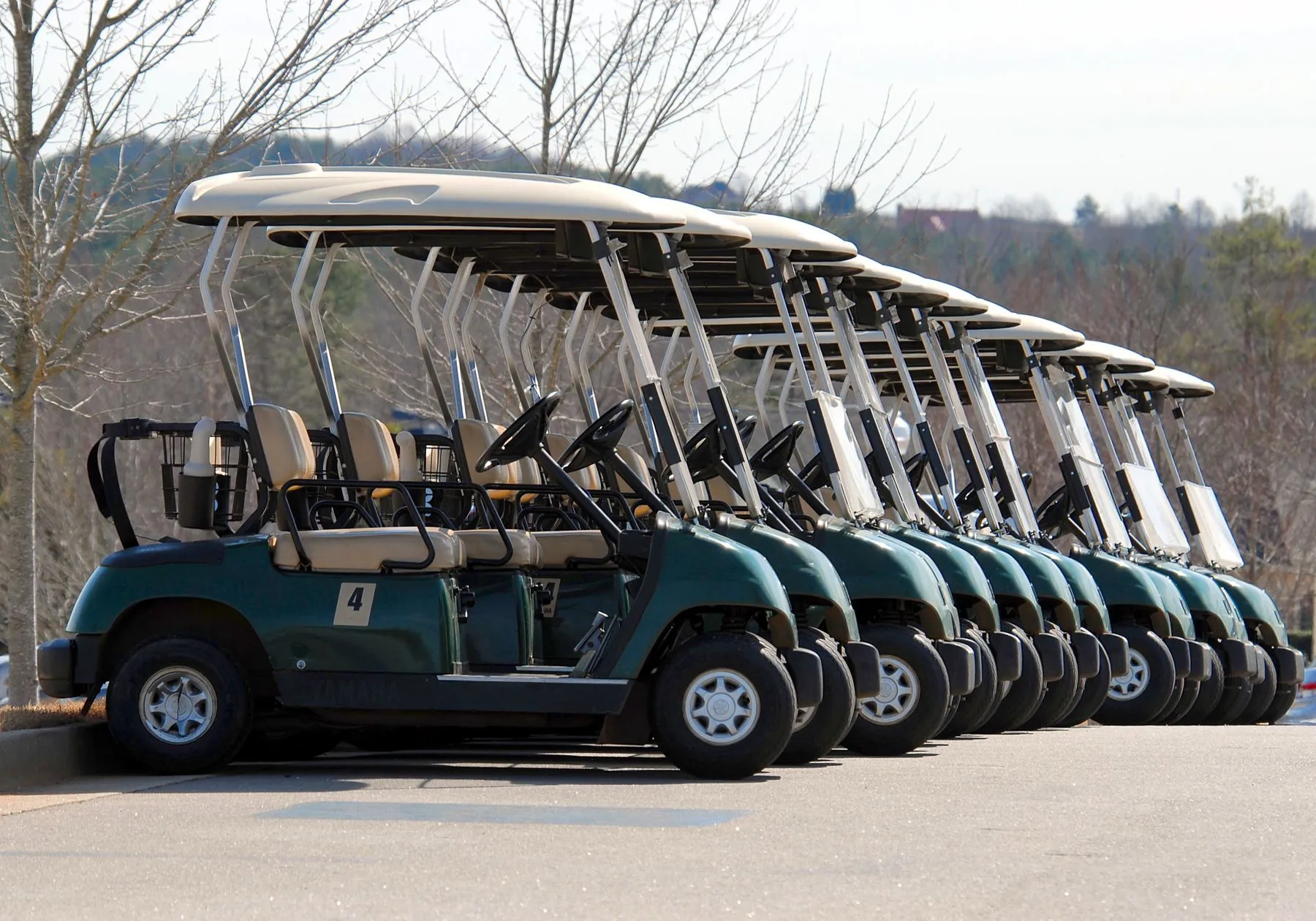
Best 12 volt golf cart batteries: four for a 48V cart
Four 12-volt batteries make a 48V cart, and that is how the EZGO RXV and the early Club Car Precedent left the factory. These are the ones worth putting in, and the honest reason a four-battery set gives you a little less range than six 8-volts.
Best picks · 5 picksUpdated Nov 5, 2026
Best 6 volt golf cart batteries: Trojan, Interstate, Duracell, Crown
Six of these under the seat is a 36V cart; eight is a 48V Yamaha built with the long-range tray. They all share one case size, so the choice comes down to amp-hours, warranty and how far you want to drive to buy them. A good set, watered monthly, lasts four to six years.
Best picks · 6 picksUpdated Nov 5, 2026